If you’ve ever worked on a power electronics project—whether designing a charger for a portable device, a power supply for a small appliance, or a filter for renewable energy equipment—you’ve probably run across two common inductor types: drum core inductors and pot core inductors. As a supplier that focuses exclusively on drum core inductors, I talk to engineers every week who mix these two up, and I get it: at first glance, both are wire wrapped around a magnetic core, and both are used to store energy in magnetic fields. But the differences run deep, and choosing the right one can make or break your project’s performance, size, and cost. Let’s break this down the way I explain it to every customer who reaches out. Drum Core Inductors
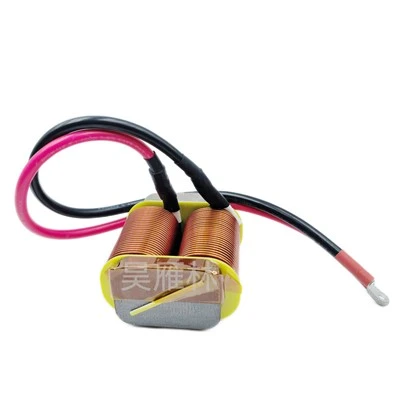
First, let’s start with the basics of how each core is built. A drum core, as the name suggests, is shaped like an old-fashioned wooden drum: it has a long, cylindrical central post (the part you wrap wire around) and two flat, disk-shaped end caps that stick out on either side. Those end caps create gaps between the edge of the central post and the outer edge of the core, which are almost always left open—no enclosure, no shell to cover them. A pot core, by contrast, is almost like a drum core wrapped in a protective shell. It has a matching central post and end caps, but it’s encased in a two-part, boxy outer shell that clicks or screws together over the wound wire, leaving almost no gaps exposed. That physical shape is the root of every other difference, and it’s not just cosmetic.
Let’s talk about magnetic properties, which are the whole point of an inductor. Inductance (the ability to store magnetic energy) depends on two things: how many times you wrap wire around the core, and the permeability of the core material, plus the geometry of the core. For drum cores, the open gaps around the central post mean that some of the magnetic field leaks out into the surrounding air—this is called “stray flux” or magnetic leakage. That might sound like a bad thing, but it’s actually an advantage in some applications. Leaked flux doesn’t interfere with nearby components (like sensors or other inductors) as much as you’d think, and drum cores tend to handle higher current loads better than similarly sized pot cores. The open design also means they run cooler under heavy current because there’s more air circulation around the wound wire—no enclosed space trapping heat.
Pot cores, on the other hand, are designed to minimize stray flux. The sealed outer shell contains almost all of the magnetic field inside the core, so you don’t have to worry about interference with other parts of your circuit. That’s a big win for compact, crowded designs where space is at a premium. But that sealing comes with tradeoffs: pot cores can trap heat, because the enclosed outer shell limits air flow, so they run hotter under the same current as a drum core of the same size. Also, because their core is enclosed, you can’t easily swap out wire windings or adjust inductance on the fly without opening the core up, which adds time to prototyping.
Next, size and form factor. If you’re building a compact device like a smartphone charger or a Bluetooth module, pot cores shine because their sealed shape is neat and flat—easy to mount on a printed circuit board (PCB) without extra shielding. But for medium-to-high current applications, like motor drivers for small robots or power supplies for LED lighting, drum cores are smaller and lighter for the same inductance rating. Wait, that might surprise you—how can something with leakage be smaller? It comes down to core material efficiency. Drum cores use more of the core’s volume for the windings: the open design lets you wrap thicker wire to carry more current, without wasting space on the outer shell of a pot core. For example, a 10 µH drum core that handles 2 amps might be a 12mm diameter cylinder, while a comparable pot core would be 15mm diameter, because the shell takes up space that could be used for windings. That’s a huge cost saver for projects where weight and PCB real estate matter.
Cost is another big factor, especially for high-volume manufacturing. Drum cores are simpler to make: they’re a single core part (the end caps are molded as one piece with the central post, usually from ferrite or iron powder) and you can wind the wire directly by hand or with an automated winding machine without extra assembly steps. Pot cores require two separate core halves (the inner part with the central post, and the outer shell), plus the material to bond or click them together after winding. That adds labor and material cost—usually 20 to 30 percent more than a comparable drum core. For OEMs building 10,000 units a month, that adds up fast.
Wait, but let’s talk about reliability, because that’s another area where the two differ. Drum cores, with their open design, are less prone to a problem called “saturation” under extreme current loads. Saturation happens when the core material can’t hold any more magnetic flux, so inductance drops sharply, which can cause your circuit to fail. Because drum cores have a larger air gap around the central post (thanks to the open end caps), they resist saturation much better. That makes them perfect for applications that handle frequent current spikes, like motor controllers or switching power supplies in industrial equipment. Pot cores, with their tight, enclosed flux path, can saturate much faster under overload, so they’re better suited for steady-state applications where current doesn’t vary much, like low-voltage power supplies for consumer electronics.
I should also mention prototyping flexibility, which is something we hear a lot from design engineers. When you’re testing a new circuit, you might need to adjust inductance halfway through prototyping—say, go from 5 µH to 7 µH just to tweak the performance. With a drum core, you can easily swap out the winding: just unwind the old wire and wrap a new one, no special tools needed. Pot cores, because they’re sealed, require you to take the whole core apart, clean out the old wire, and rewind inside the shell, which is more time-consuming and often leads to mistakes. For startups or small teams working on tight deadlines, that flexibility is a huge advantage, and it’s why so many of our customers come back to drum cores for their prototype runs.
Of course, no component is perfect, so let’s be honest about where each falls short. Drum cores’ stray flux, for example, can be a problem in sensitive circuits. If you’re building a medical device that has both power circuits and small sensor circuits, the leaked magnetic field from a drum core might interfere with the sensors, causing noisy readings. In that case, a pot core’s sealed design is better, because it contains the flux. Also, drum cores are less protected from physical damage—they have no outer shell, so if you drop a PCB with a drum core on it, the core can crack, or the windings can get snagged. Pot cores’ outer shell protects them from that kind of wear and tear, which is why they’re used in more rugged consumer goods, like televisions or home appliances that get moved around.
Another common question I get: when should I pick one over the other? Let’s put it in simple terms. If you’re working on a power supply, motor driver, or LED lighting design that needs to handle high current, resist saturation, and keep costs low, drum core inductors are the way to go. That’s exactly what we specialize in at our company, and we’ve supplied drum cores to everything from electric scooter motor controllers to solar panel inverters. If you’re building a compact, low-current device with sensitive components that can’t handle flux interference, like a wireless earbud charger or a smart watch, a pot core will work better. Just make sure you account for the higher cost and lower heat dissipation that comes with the sealed shell.
I’ve seen engineers make the mistake of just picking the cheaper option without checking their project’s needs, too. A few months ago, a design team came to us looking for a replacement for a pot core they’d been using in a 12V LED strip power supply. They were over budget, so we suggested a drum core. They were worried about stray flux, but we helped them test it, and it worked perfectly—their PCB was smaller, the inductor ran 10 degrees cooler, and they saved 25 percent on parts. That’s the kind of win that comes from understanding the difference, not just picking a component that looks similar.
At the end of the day, both drum core and pot core inductors have their place, but the choice boils down to three key factors: your current load, your need for flux containment, and your budget. For us as drum core inductor suppliers, we’re biased because we know how well they perform for the majority of medium-to-high power applications, but we also make sure to be honest with customers when a pot core is a better fit. We’ve built our business on that transparency, and it’s why so many engineers trust us for their inductor needs.
If you’re designing a new project and aren’t sure which inductor is right for you—whether you’re working on a power supply, motor, or any other circuit that needs energy storage for alternating current—we’re here to help. We can walk you through your requirements, help you test prototypes, and supply drum core inductors tailored to your exact specs, no matter the volume. Reach out to our team today to discuss your project and get a custom quote.
Filter Inductors References
- Magnetic Components for Power Electronics, Third Edition, V. Murti, CRC Press
- Inductor Core Design and Application Guide, Ferrite Core Manufacturers Association
- Power Electronics Handbook, Fourth Edition, Edited by Muhammad H. Rashid
- Comparative Analysis of Inductor Core Types for Switch Mode Power Supplies, Journal of Power Electronics, 2019
Shenzhen Haoyanlin Electronics Co., Ltd.
With abundant experience, we are one of the most professional drum core inductors manufacturers and suppliers in China. Please feel free to buy advanced drum core inductors made in China here from our factory. All custom made products are with high quality and competitive price.
Address: Room A306, Building A, Hongwan Business Center, No.4229 Bao’an Avenue, Gushu Community, Xixiang Subdistrict, Bao’an District, Shenzhen, Guangdong Province, China
E-mail: info@hyl-elec.com
WebSite: https://www.hyl-elec.com/
